At a Glance
- Best months: October – April
- Dune height: up to 150m (Erg Chebbi)
- Camel trek: 1–2 hours to camp
- Distance from Marrakech: ~9 hours drive
- Nearest town: Merzouga village
- Languages: Berber, Arabic, French
- Currency: Moroccan Dirham (MAD)
- Ideal duration: 2 nights minimum
There is a moment — sometime around late afternoon, when you crest the first great dune of Erg Chebbi and the entire Sahara opens up before you — when words genuinely fail. A sea of amber and ochre rolls away to the horizon, the silence is vast and absolute, and Morocco reveals itself as something far beyond the medinas and mountains you have already explored.
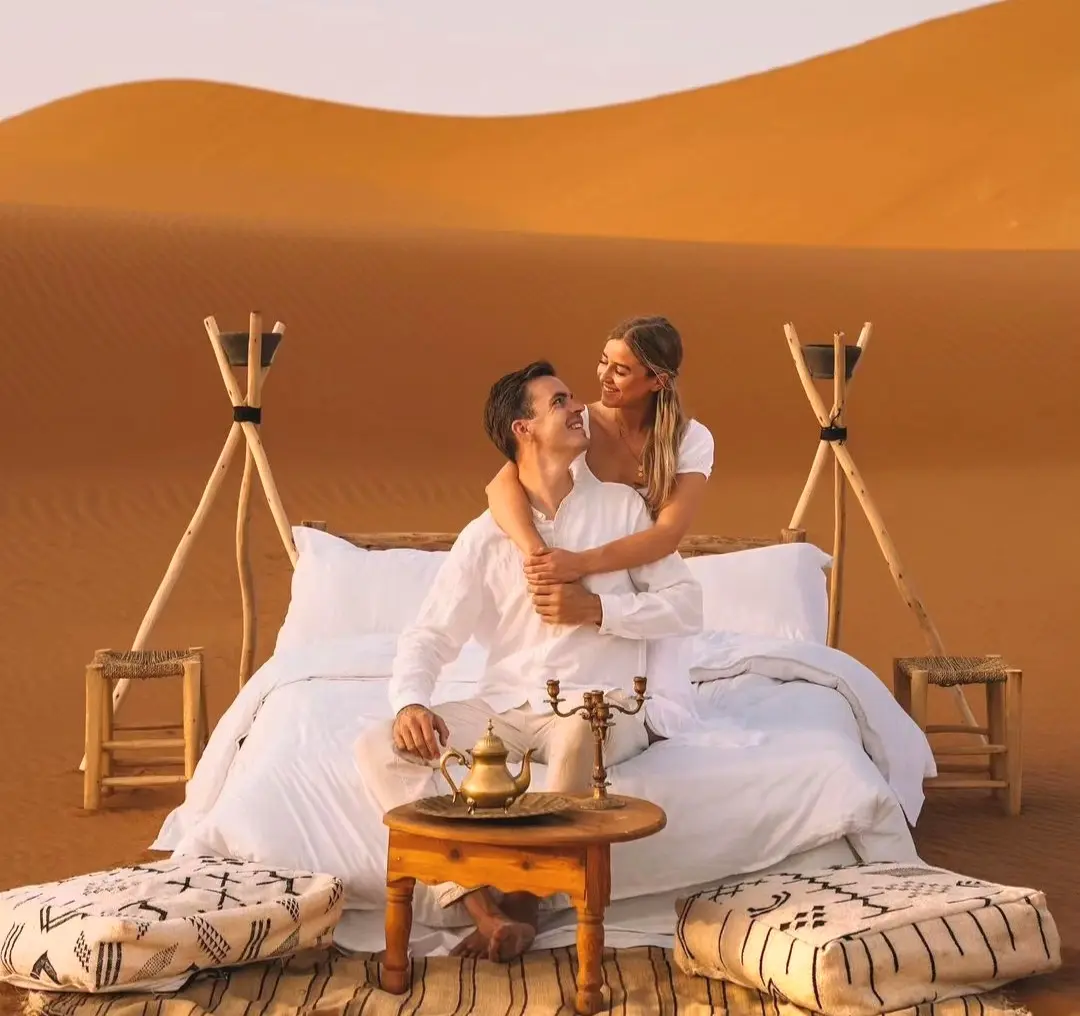
The dunes of Erg Chebbi, rising outside the village of Merzouga in south-east Morocco, are among the most spectacular desert landscapes in all of Africa. Reaching up to 150 metres in height, these wind-sculpted mountains of sand shift colour through the day — pale gold at noon, deep terracotta at dusk, soft violet just before sunrise.
A Sahara desert tour with Sahara Trails is built around this extraordinary landscape: a guided camel trek in at sunset, a night in a luxury Berber camp beneath an impossible canopy of stars, and an early-morning climb to the summit of the dunes to watch the Sahara wake up. It is, without question, one of the great travel experiences in the world.
What Is Erg Chebbi?
Erg Chebbi is an isolated sand sea — an erg — located in the Draa-Tafilalet region of south-east Morocco, close to the Algerian border. Unlike the vast, undifferentiated sands of the deep Sahara, Erg Chebbi is an island of enormous dunes rising sharply from a flat stony plain, making it one of the most visually dramatic desert formations in all of North Africa.
The dunes stretch roughly 22 kilometres north to south and 5 kilometres wide at their broadest point. The highest peaks exceed 150 metres and require 20–30 minutes of steady climbing to summit — hard work rewarded with a panoramic view that stretches to the horizon in every direction.
"Erg Chebbi is not simply beautiful sand. It is one of those rare places on earth where the landscape actively changes the way you think — where silence becomes something you can feel."
The Experiences
Guided Camel Trek at Sunset
The classic Merzouga experience: a 1–2 hour guided trek by camel across the base of the dunes as the sun descends. Your guide leads a string of camels along the foot of Erg Chebbi, the light turning amber and deep rose. You arrive at camp as the first stars appear.
Overnight in a Luxury Berber Camp
Our camps offer private tented suites with proper beds and linen, traditional lanterns, and a central communal fire where Berber musicians play beneath a sky undimmed by light pollution. A full Moroccan dinner is prepared fresh each evening.
Sunrise from the Summit of the Dunes
Wake before dawn and climb to the top of the highest dune near camp. As the light builds, the Sahara turns from deep indigo to gold — layers of dune shadow and ridge light that no photograph fully captures. A 30-minute climb that earns a memory for life.
Sandboarding on Erg Chebbi
For those who want a little more adrenaline with their sunrise, sandboarding down a 100-metre dune face is exactly as fun as it sounds. Boards are provided at camp, and guides know the best runs.
Gnawa Music Around the Campfire
Evenings in camp are accompanied by the hypnotic rhythms of Gnawa music — a centuries-old tradition of the Saharan Berber people. Drums, castanets, and call-and-response singing under the Milky Way.
Stargazing in the Sahara
With zero light pollution for hundreds of kilometres, the night sky above Erg Chebbi is staggering. The Milky Way is visible to the naked eye on clear nights, and shooting stars are routine. Lie back on the warm sand and let the universe arrive.
A Day in the Desert
Here is what a typical overnight Sahara experience looks like with Sahara Trails:
Your driver meets you at your accommodation. Lunch, rest, and a short briefing from your guide. Collect any last-minute essentials from the village.
Mount up. Your guide leads the caravan along the base of Erg Chebbi as the afternoon light softens. Approximately 1.5 hours of slow, contemplative riding.
Arrive at camp as the dunes turn deep amber. Climb the nearest ridge for sunset views. The best photographs of your trip will happen here.
Traditional tagine and couscous served by lantern light. After dinner, Berber musicians play around the fire. Mint tea, conversation, stars.
An early start for the dune summit. 20–30 minutes of climbing rewarded by Morocco's most extraordinary morning view.
Return to Merzouga by camel or 4×4 depending on preference. Breakfast at a guesthouse. Continue your Morocco itinerary refreshed and humbled.
When to Visit Merzouga
The Sahara is an extreme environment and timing your visit correctly is important. The ideal window is a long one — October through April — covering both autumn and spring as well as the winter months that many people mistakenly imagine are too cold. Desert nights in December and January are genuinely chilly (near freezing), but days are clear and cool and the dunes are at their least crowded.
Practical Information
| Detail | Information |
|---|---|
| Location | Merzouga, Draa-Tafilalet, south-east Morocco |
| Distance from Marrakech | ~560 km — approx. 9 hours by car or private transfer |
| Distance from Fes | ~450 km — approx. 7.5 hours by car or private transfer |
| Tour duration | 1-night tours available; 2 nights recommended |
| Camp facilities | Private tented suites, flush toilets, hot showers (standard camp), or luxury ensuite (premium) |
| Meals | Full traditional dinner and breakfast included |
| What to bring | Warm layer for evenings, sunscreen, sunglasses, small overnight bag, camera |
| Physical fitness | Camel trekking is suitable for all fitness levels; dune climbing is moderate |
Frequently Asked Questions
What is the best time of year to visit Merzouga for a desert tour?
The ideal months are October through April. Temperatures are comfortable during the day (18–28°C), nights are cool and clear, and the dunes are less crowded than the summer peak. July and August regularly exceed 40°C and are not recommended.
How long should I spend in the Merzouga desert?
We recommend a minimum of 2 nights. One night gives you the sunset camel trek and overnight camp experience; a second night lets you explore further into the dunes, try sandboarding, and experience the desert without rushing.
Are Merzouga desert tours suitable for children?
Yes. Camel trekking is gentle and suitable for children of most ages. Camps have family tents, child-friendly meals, and safe dune environments.
What should I pack for an overnight Sahara camp?
Pack light: warm layer for nights, sunscreen, sunglasses, comfortable shoes, scarf, and camera. Leave large luggage in your hotel.
How do I get from Marrakech to Merzouga?
The journey takes around 9 hours via High Atlas mountains, Ouarzazate, Dades Gorge, and Todra Gorge. Most travelers choose a 3–5 day guided tour.
Is the luxury Berber camp really comfortable?
Yes. Premium camps include private beds, ensuite bathrooms, hot showers, electricity, and full meals. It is luxury glamping in the desert.